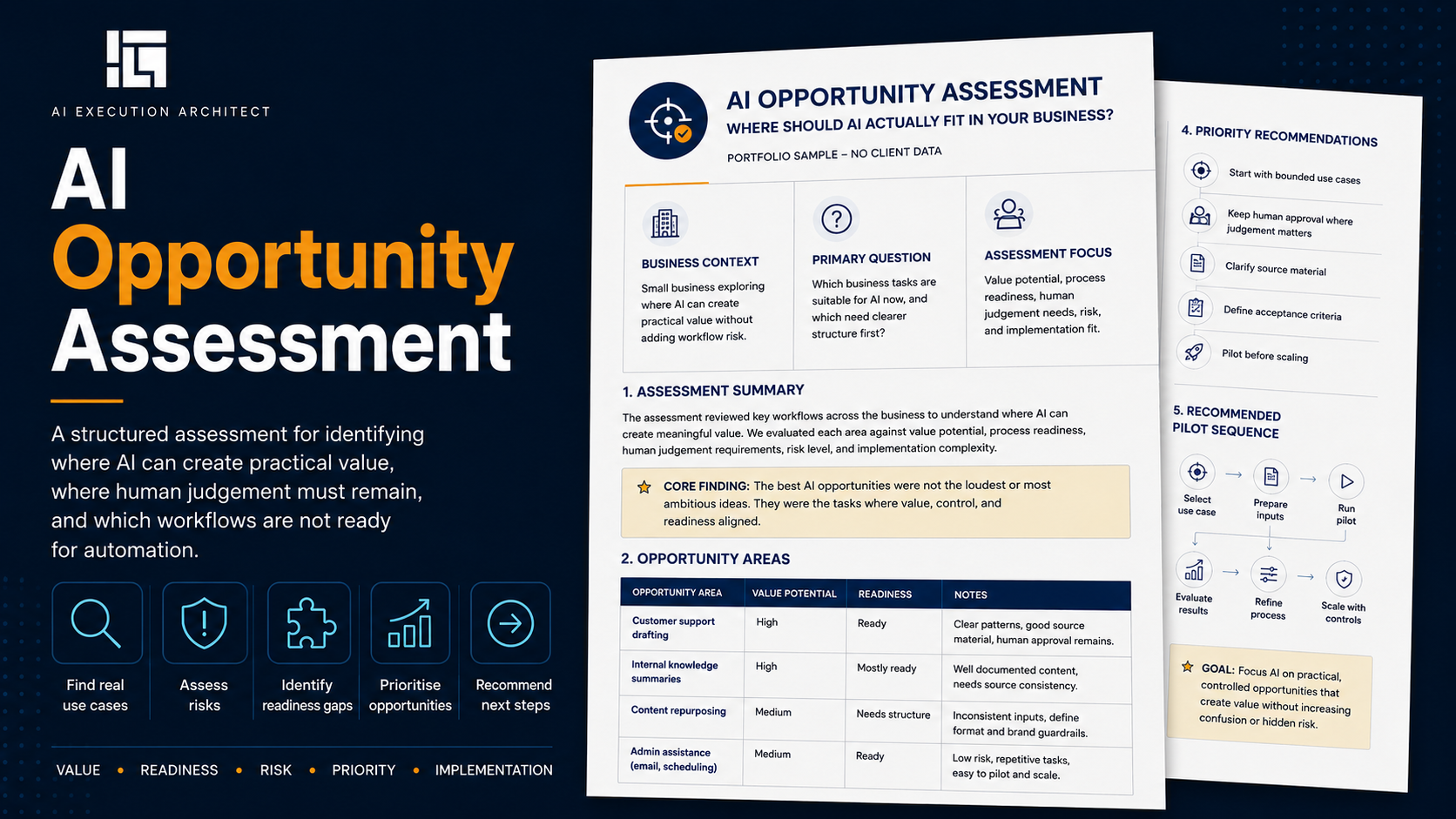
AI Opportunity Assessment: Where Should AI Actually Fit in Your Business?
A structured assessment for identifying where AI can create practical value, where human judgement must remain, and which workflows are not ready for automation.
AI adoption often starts with the wrong question
The question is not simply whether AI can perform a task.
The real question is whether AI can improve the workflow without creating more review, confusion, risk, or hidden dependency than the value it adds.
Businesses often begin with tools or automation before they have clarified:
- —which workflows are worth improving
- —whether the task is suitable for AI
- —whether the source material and inputs are ready
- —where human judgement must remain
- —who will own, review, and maintain the workflow
- —what the operational risk is if the output is wrong
Use AI where it creates measurable value inside a workflow with clear inputs, defined boundaries, appropriate human judgement, and accountable ownership.
Five areas used to assess an AI opportunity
Business value
Does the opportunity improve time, cost, quality, capacity, revenue, or decision speed in a way that can be measured and justified?
Task suitability
Is the work repeatable, bounded, and describable, or is it highly ambiguous and dependent on judgement that cannot be specified in advance?
Input readiness
Are the source material, data, context, constraints, and examples stable and consistent enough for reliable AI use without constant manual correction?
Human judgement
Where must approval, interpretation, ethics, sensitivity, authority, or accountability remain human-led, and what happens if that boundary is not defined clearly?
Operational fit and risk
Who owns, reviews, approves, and maintains the workflow, and what is the operational consequence if the AI output is wrong, incomplete, or misused?
Not every AI opportunity should move directly into automation
Each candidate use case is assessed against the five criteria and assigned one of four decision outcomes.
Proceed to controlled pilot
Use when there is clear value, usable inputs, manageable risk, and a defined human role.
Redesign before pilot
Use when the opportunity is valuable but the workflow has weak inputs, unclear handoffs, undefined acceptance criteria, or unclear ownership.
Keep human-led
Use when the task depends heavily on judgement, sensitivity, authority, or accountability.
Do not prioritise
Use when the business value is low, the process is unstable, or implementation effort is likely to exceed the benefit.
How different AI opportunities may be assessed
| CANDIDATE USE CASE | VALUE | READINESS | RISK | ASSESSMENT DECISION |
|---|---|---|---|---|
| Internal meeting summaries and action capture | High | High | Low to medium | Proceed to controlled pilot with approved inputs, fixed output structure, and human confirmation |
| Drafting routine client follow-up emails | Medium to high | Medium | Medium | Pilot after workflow design, with defined context, tone, exclusions, approval, and escalation rules |
| Automated client recommendations | High | Low | High | Do not automate yet. Keep final recommendations human-led |
| Reformatting approved content for multiple channels | Medium | High | Low to medium | Suitable for early implementation with locked source content and claim validation |
Internal meeting summaries and action capture
Proceed to controlled pilot with approved inputs, fixed output structure, and human confirmation
Drafting routine client follow-up emails
Pilot after workflow design, with defined context, tone, exclusions, approval, and escalation rules
Automated client recommendations
Do not automate yet. Keep final recommendations human-led
Reformatting approved content for multiple channels
Suitable for early implementation with locked source content and claim validation
A controlled path from opportunity to pilot
Choose a bounded workflow
Select one workflow with clear value and limited downside if the output is wrong.
Define the human-AI boundary
Specify what AI may support and what a person must review, decide, or approve.
Lock sources and constraints
Fix the source material, context, constraints, exclusions, and acceptance criteria before generation begins.
Assign ownership
Name the source owner, reviewer, approver, and workflow owner before the pilot starts.
Run a measurable pilot
Track output quality, review time, correction patterns, and operational risk throughout.
Use evidence to scale, redesign, or stop
Base the next decision on what the pilot evidence shows, not on initial expectations.
Choose a bounded workflow
Select one workflow with clear value and limited downside if the output is wrong.
Define the human-AI boundary
Specify what AI may support and what a person must review, decide, or approve.
Lock sources and constraints
Fix the source material, context, constraints, exclusions, and acceptance criteria before generation begins.
Assign ownership
Name the source owner, reviewer, approver, and workflow owner before the pilot starts.
Run a measurable pilot
Track output quality, review time, correction patterns, and operational risk throughout.
Use evidence to scale, redesign, or stop
Base the next decision on what the pilot evidence shows, not on initial expectations.
What an AI Opportunity Assessment provides
AI opportunity map
Candidate use cases ranked by value, readiness, risk, and decision status.
Prioritised shortlist
The small number of opportunities worth piloting first, with a clear rationale.
Human-AI decision boundaries
Clear definition of what AI may support and where human judgement or approval must remain.
Readiness gaps and pilot recommendation
The prerequisites, controls, owners, measures, and evidence needed before scaling.
View the sample assessment
The source document explains the opportunity screening criteria on page 1 and provides the opportunity map, prioritisation logic, recommended sequence, and deliverables on page 2.
PORTFOLIO SAMPLE ONLY · NO CLIENT DATA IS INCLUDED
Need to decide where AI should fit before you invest?
An AI Opportunity Assessment helps clarify which workflows are worth pursuing, which need redesign first, and where human judgement must remain.
It is designed for businesses that want a practical starting point rather than a list of tools or generic automation ideas.
The AI Opportunity Readiness Assessment is the structured engagement that produces the outputs described on this page.
View service details →