The AI Execution Architecture Framework
Turn AI interest into workable business execution.
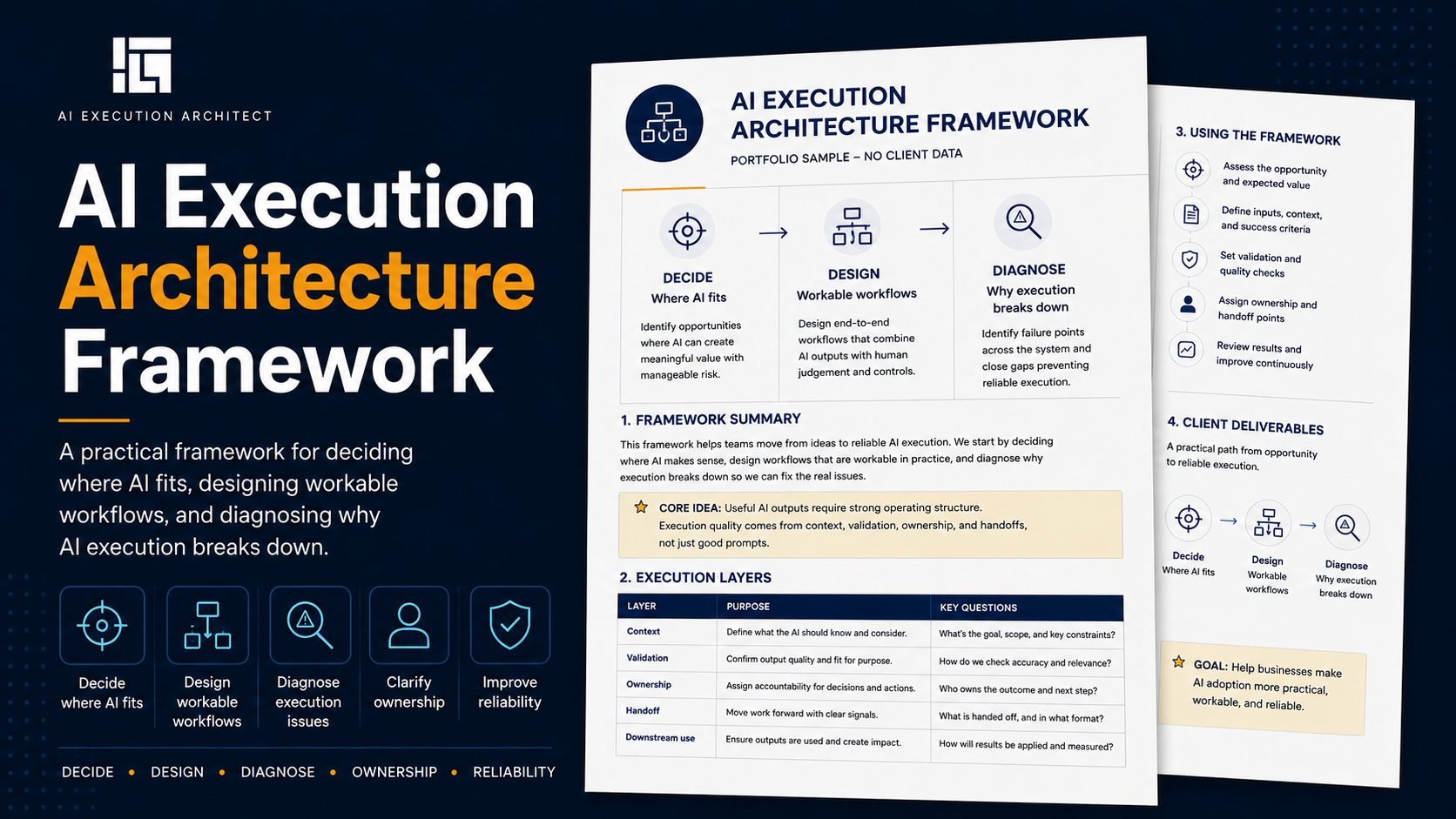
A practical framework for deciding where AI fits, designing workable AI-assisted workflows, and diagnosing why execution becomes unreliable.
It connects AI capability to business value, context, validation, ownership, handoffs, and dependable execution.
AI adoption often breaks between capability and execution
Many businesses approach AI through tools, pilots, or prompts.
Those activities may produce acceptable outputs, but they do not automatically create a workflow that can be trusted, handed off, maintained, or scaled.
The execution problem usually sits in the operating structure around the AI:
- —the use case was not assessed properly
- —the workflow was not ready
- —source context was not controlled
- —validation happened too late
- —ownership and authority were unclear
- —handoffs lost important information
- —weak outputs travelled into decisions and later work
- —manual correction became part of normal operations
AI capability is not reliable execution. Reliable execution requires a workflow that preserves context, validates outputs at the right points, assigns ownership, and controls how outputs move into decisions and downstream work.
The framework at a glance
Three connected stages that move a business from AI interest to controlled, reliable execution.
Assess value, readiness, risk, and human decision boundaries.
Define inputs, outputs, validation, ownership, decisions, and handoffs.
Trace context loss, review burden, hidden correction, and structural weaknesses.
Note: The framework can be used from the beginning of AI adoption or applied to an existing workflow that has already become difficult to trust.
DECIDE: Determine where AI belongs
The DECIDE stage prevents businesses from starting with tools or automation before clarifying the business case, workflow readiness, risk, and decision boundaries.
Where can AI create practical value?
- —task volume
- —repetition
- —delay
- —information load
- —quality variation
- —capacity constraints
- —business impact
Is the workflow ready?
- —source quality
- —process clarity
- —exception patterns
- —data access
- —existing controls
- —operational ownership
Where must human judgement remain?
- —decision consequence
- —ambiguity
- —regulatory or client risk
- —ethics and sensitivity
- —accountability
- —authority boundaries
What should not be automated yet?
- —unstable rules
- —weak source material
- —unclear accountability
- —high exception rates
- —limited evidence of value
- —unsafe downstream consequences
DESIGN: Build a workable AI-assisted workflow
The DESIGN stage defines the operating structure around the AI task. It ensures that reliable execution does not depend on a stronger prompt or one person carrying missing context.
Purpose and boundary
Define what the AI task is intended to support, what it must not decide, and where the output will be used.
Controlled inputs
Specify approved sources, current decisions, required context, constraints, and exclusions before generation begins.
Output specification
Document required structure, acceptance criteria, evidence requirements, prohibited claims, and expected format.
Validation design
Place checks before outputs influence decisions, publication, client use, operational handoff, or future reuse.
Ownership and authority
Assign named responsibility for source input, output review, approval, exceptions, and workflow maintenance.
Handoff and reuse
Record decision history, caveats, source references, approval status, and unresolved issues for downstream use.
DIAGNOSE: Identify why execution becomes unreliable
The DIAGNOSE stage separates visible symptoms from the structural conditions underneath them.
Review work keeps expanding
Validation is late or acceptance criteria are weak.
Trace where review begins and what reviewers repeatedly reconstruct.
Outputs vary across similar tasks
Inputs, source material, or decision boundaries are not controlled.
Compare source packages, instructions, constraints, and prior decisions across cycles.
One person keeps fixing the system
Critical context and judgement sit inside an individual rather than inside the workflow.
Map tacit corrections, exceptions, dependencies, and undocumented decisions.
Errors appear after handoff
The workflow loses context, ownership, or validation status as outputs travel.
Follow the output through decisions, teams, clients, and future reuse.
AI looks fast but delivery is not
Draft speed is being offset by hidden correction, clarification, rework, and review burden.
Measure total operating effort, not only generation time.
How the framework supports client work
A practical five-step implementation sequence.
Assess the opportunity
Determine the expected business value, readiness, risk, and human decision boundaries.
Define the workflow structure
Document the purpose, inputs, context, output requirements, constraints, and success criteria.
Set validation controls
Place checks before outputs influence decisions, clients, publication, or downstream work.
Assign ownership and handoffs
Clarify who supplies inputs, reviews outputs, approves final use, manages exceptions, and updates the source material.
Review evidence and improve
Track output quality, review burden, corrections, failures, and operational results.
The purpose is not to add unnecessary process. It is to add the minimum operating structure required for dependable execution.
Client deliverables produced through the framework
These five outputs are listed in the client-deliverables section on page 2 of the framework PDF.
Opportunity and readiness view
Shows where AI can create value, where preparation is required, and what should remain outside scope.
Workflow architecture map
Defines inputs, output movement, validation points, ownership, decisions, handoffs, and reuse.
Failure diagnosis
Explains why an existing AI-assisted workflow is becoming harder to trust, review, or maintain.
Prioritised design recommendations
Sets out which controls should be added first without creating unnecessary process weight.
Implementation roadmap
Translates the framework into a practical pilot, redesign, and scaling sequence.
This is not a generic AI methodology
Not this
- ✕prompt-writing system
- ✕AI tool recommendation list
- ✕automation-everything approach
- ✕generic technology-selection model
- ✕assumption that every workflow needs AI
This
- ✓operational decision framework
- ✓workflow architecture method
- ✓reliability diagnostic model
- ✓human-AI responsibility structure
- ✓practical path from opportunity to execution
View the AI Execution Architecture Framework
Page 1 explains the DECIDE, DESIGN, and DIAGNOSE structure. Page 2 covers the workflow architecture layers, diagnostic signals, and client deliverables.
Portfolio sample only. No client data is included.
Apply the framework to your business
AI Opportunity Readiness Assessment
For organisations that are still deciding where AI should fit and which use cases are ready.
Explore the AssessmentWorkflow Stability Audit
For organisations already using AI where review, correction, inconsistency, or handoff problems are increasing.
Explore the AuditMove from AI experimentation to controlled execution
The AI Execution Architecture Framework provides a structured way to decide where AI fits, design how the workflow should operate, and diagnose what is preventing reliable execution.
It is designed for businesses that need practical operating clarity, not another list of AI tools.