Sample AI Workflow Reliability Audit
Why does an AI workflow become harder to trust over time?
A diagnostic sample showing how usable AI outputs can hide increasing review burden, repeated correction, weak validation, unclear ownership, and unreliable handoffs.
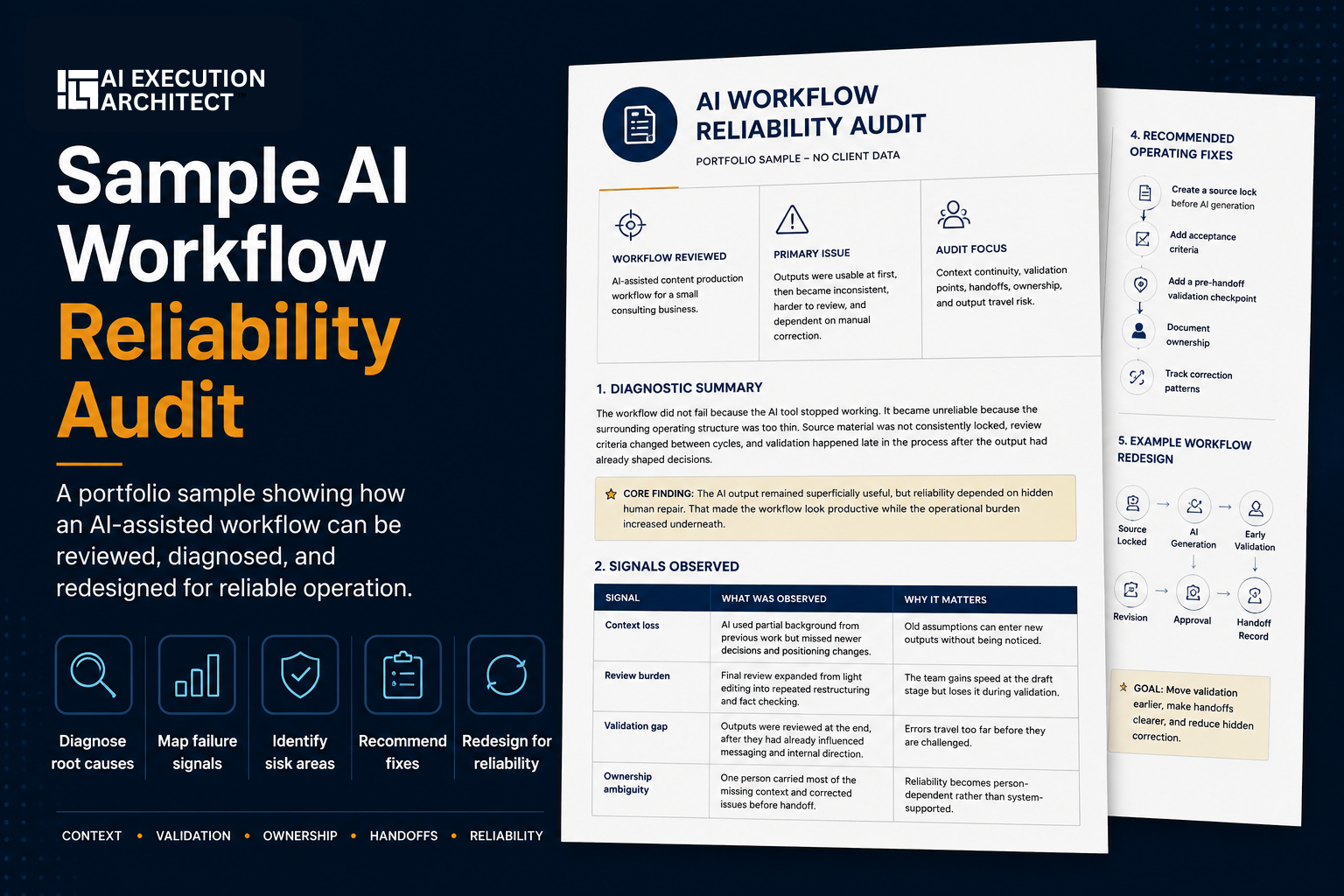
A usable AI output is not the same as a reliable workflow
Many AI workflows appear successful because the first draft is usable.
The reliability problem becomes visible later, when the output must be:
- —reviewed
- —corrected
- —approved
- —adapted into another format
- —passed to another person
- —reused in later work
- —treated as a source for another AI task
The workflow may still move, but only because people continue repairing missing context, inconsistent structure, weak claims, tone problems, and unclear decisions after the AI has produced the output.
The output may still look acceptable because people are quietly repairing the workflow around it.
The workflow examined in this sample
A content-production workflow using transcripts, notes, prior content, AI drafting, human editing, and channel repurposing.
A content-production workflow using transcripts, notes, prior content, AI drafting, human editing, and channel repurposing.
The drafts remain usable, but editing time keeps increasing and tone varies across channels.
Source material, prompt structure, review process, approval criteria, and repurposing handoff.
Five places where reliability can weaken
Each area is assessed for current condition and reliability risk.
Source material
Transcripts, notes, and prior content are used inconsistently.
The AI receives uneven context, so the same instruction can produce different-quality outputs.
Prompt structure
One prompt is expected to handle drafting, tone, structure, and repurposing.
Too much responsibility sits inside the prompt rather than being distributed across the workflow.
AI output
The draft is usable but requires repeated correction.
Quality depends on reviewer memory and manual intervention.
Human editing
The reviewer fixes accuracy, tone, structure, flow, and channel fit at the same time.
Heavy editing hides workflow weakness and increases review fatigue.
Repurposing and handoff
Articles, social posts, and email versions are created without a shared adaptation rule.
The message drifts as it moves between formats and channels.
Signals that the workflow is becoming structurally unreliable
These signals are set out on page 1 of the sample audit.
Heavy editing after every AI draft
The output is not ready to move forward without major repair.
Missing review criteria and an unclear source hierarchy.
Tone varies across drafts
Style and audience context are not being carried forward consistently.
Tone guidance is implied rather than operationalised.
Repurposed content drifts from the original point
The message changes as it moves into new formats.
There are no channel-specific adaptation rules.
One person keeps correcting the same issues
Reliability depends on individual memory rather than the workflow.
Ownership, quality thresholds, and correction rules are not documented.
The visible symptom is not always the root issue
The workflow treats the AI output as the main object to fix instead of controlling the conditions that produce, review, approve, and reuse it.
Validation happens too late.
The workflow continues moving, but reliability depends on hidden human correction.
The problem is not only the prompt. The workflow lacks stable source control, review criteria, approval rules, and handoff structure.
Four changes that improve reliability
These recommendations are shown in the "Recommended fixes" section on page 2 of the sample.
Create a source checklist
Before using AI, confirm the approved source material, audience, claim boundaries, exclusions, and channel goal.
Reduces context loss and inconsistent drafts.
Split generation from adaptation
Use one stage for the main draft and separate stages for LinkedIn, email, website, or other channel adaptation.
Prevents message drift across formats.
Define review criteria
Create a short checklist for tone, accuracy, structure, claims, calls to action, and publishing readiness.
Makes quality control repeatable instead of memory-based.
Add an approval handoff
Mark each output as draft, reviewed, approved, ready to publish, or ready for reuse.
Clarifies ownership and reduces repeated checking.
From hidden correction to controlled execution
- ✕inconsistent source context
- ✕one oversized prompt
- ✕late review
- ✕heavy correction
- ✕unclear approval
- ✕message drift
- ✕person dependency
- ✓source checklist
- ✓main AI draft
- ✓human review
- ✓channel adaptation
- ✓final approval
- ✓publishing and reuse log
- ✓visible ownership
What a workflow reliability audit helps clarify
Prompt issue or workflow issue?
Separates weaknesses in the instruction from weaknesses in the operating structure.
Where review burden is coming from
Identifies whether reviewers are editing normally or reconstructing missing context.
Why outputs vary
Traces inconsistency back to source material, boundaries, acceptance criteria, or handoff design.
Where ownership is unclear
Shows who should supply inputs, review outputs, approve use, and maintain the workflow.
Which fixes should happen first
Prioritises changes that improve reliability without adding unnecessary process.
Typical audit deliverables
Workflow map
A visual view of how inputs, AI outputs, reviewers, decisions, and handoffs currently connect.
Failure-signal analysis
A structured explanation of visible symptoms and the conditions creating them.
Reliability diagnosis
A clear account of why the workflow is becoming harder to trust, review, or maintain.
Prioritised operating fixes
Practical recommendations covering source control, validation, ownership, handoffs, and reuse.
Redesign sequence
A proposed workflow structure showing which changes should be implemented first.
View the sample workflow audit
Page 1 explains the workflow reviewed, observed reliability risks, and failure signals. Page 2 presents the diagnosis, recommended fixes, revised workflow, and expected outcome.
Portfolio sample only. No client data is included.
Is your AI workflow producing more review, correction, and rework than expected?
A Workflow Stability Audit identifies where reliability is breaking down and which operating controls should be added first.
AI Execution Architecture Framework
The wider framework for deciding where AI fits, designing workable workflows, and diagnosing execution failure.
View the framework →AI Opportunity Assessment
A structured resource for identifying which AI opportunities are worth pursuing and which workflows need preparation first.
View the assessment →