Before-and-After AI Workflow Redesign Case Study
From productive on the surface to reliable underneath
A practical case study showing how an AI-assisted workflow was redesigned with clearer source control, earlier validation, written acceptance criteria, visible ownership, and stronger handoffs.
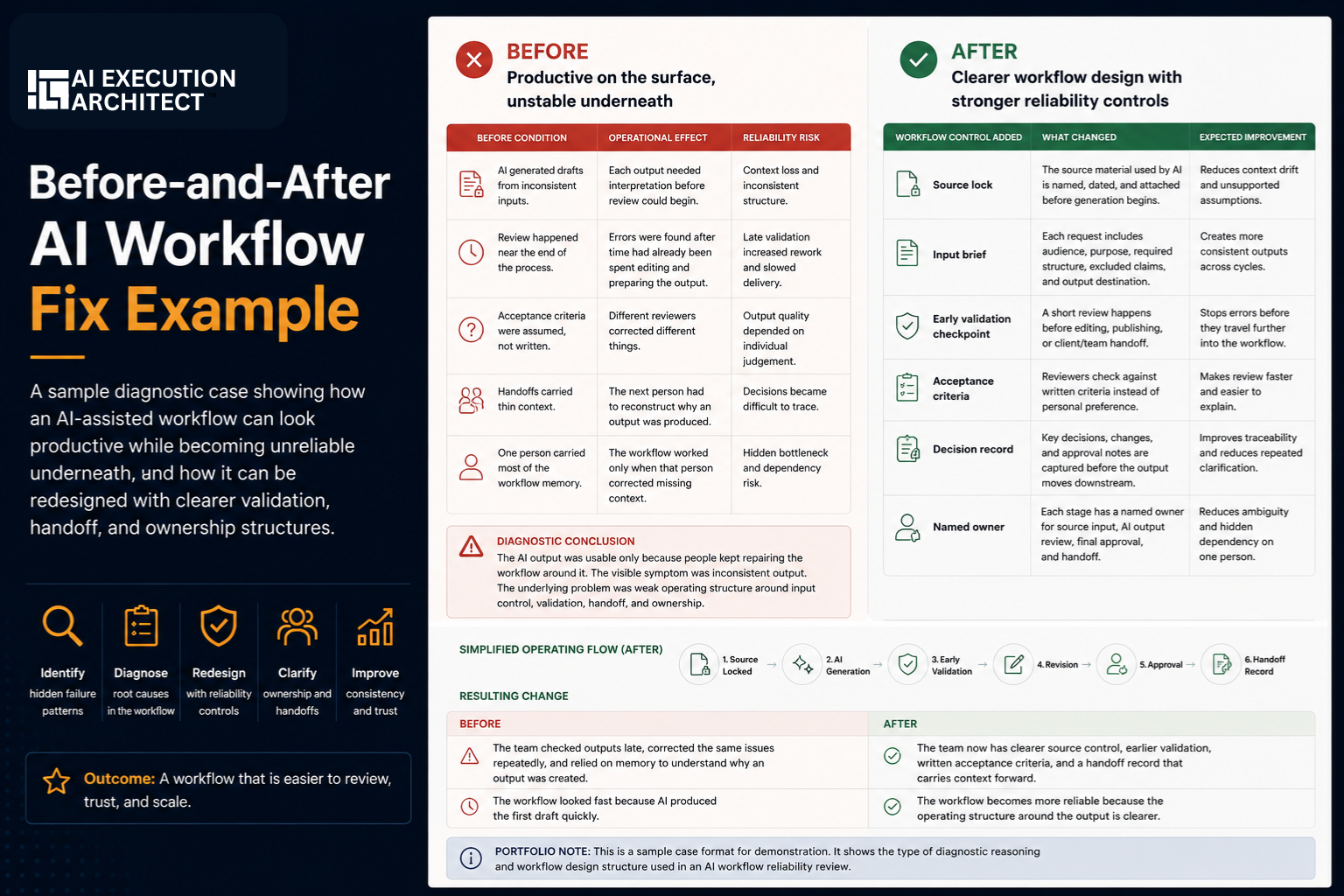
Case-study overview
An AI-assisted content production workflow used by a small consulting business. The workflow generated drafts, prepared outputs for review, and moved content through to publication and client use.
Outputs were usable at first, then became inconsistent, harder to review, and increasingly dependent on manual correction. The workflow appeared fast but required growing effort to maintain.
The workflow did not fail because the AI tool stopped working. It became unreliable because the surrounding operating structure was too thin. Source material, review criteria, validation timing, and ownership were all unclear.
Productive on the surface, unstable underneath
Five conditions that made the workflow look productive while reliability declined.
Inconsistent inputs
AI generated drafts from inconsistent source material and instructions.
Each output needed interpretation before review could begin.
Context loss and inconsistent structure.
Late review
Review happened near the end of the process.
Errors were discovered after time had already been spent editing and preparing the output.
Late validation increased rework and slowed delivery.
Assumed acceptance criteria
Quality expectations were understood informally but not written.
Different reviewers corrected different things.
Output quality depended on individual judgement.
Thin handoffs
The next person received the output without enough source context, rationale, or decision history.
The recipient had to reconstruct why the output had been produced.
Decisions became difficult to trace.
Hidden workflow memory
One person carried most of the workflow context and history.
The workflow functioned only when that person corrected missing information.
A hidden bottleneck and person-dependency risk developed.
Diagnostic conclusion
The AI output was usable only because people kept repairing the workflow around it.
The visible symptom was inconsistent output. The underlying problem was weak operating structure around input control, validation, handoff, and ownership.
The workflow looked productive because the first draft appeared quickly. But reliability depended on hidden human repair. That made the workflow look productive while the operational burden increased underneath.
The solution was not a stronger prompt. It was a redesigned operating structure with clearer inputs, earlier validation, written acceptance criteria, visible ownership, and stronger handoffs.
The solution was not a single stronger prompt
Improving the prompt reduced some inconsistency. But the deeper problem was that the workflow had no reliable structure around the AI task. The redesign added operating controls at each stage.
Six controls added to the redesigned workflow
Each control addresses a specific reliability gap identified in the before-state diagnosis.
Source lock
The source material used by AI is named, dated, and attached before generation begins.
Reduces context drift and unsupported assumptions.
Input brief
Each request includes the audience, purpose, required structure, excluded claims, constraints, and output destination.
Creates more consistent outputs across cycles.
Early validation checkpoint
A short review happens before editing, publishing, client use, or team handoff.
Stops errors before they travel further into the workflow.
Written acceptance criteria
Reviewers check the output against documented criteria instead of personal preference.
Makes review faster, more consistent, and easier to explain.
Decision record
Key decisions, changes, caveats, and approval notes are captured before the output moves downstream.
Improves traceability and reduces repeated clarification.
Named ownership
Each stage has a named owner for source input, AI-output review, final approval, and handoff.
Reduces ambiguity and hidden dependency on one person.
Simplified operating flow (after)
Six stages, each with a named owner, defined inputs, and a clear handoff.
Approved source material, constraints, and current decisions are confirmed.
The AI produces an output against a defined brief.
The output is checked before significant editing or downstream use.
Corrections are made against written criteria.
A named person confirms the output is suitable for its intended use.
The output moves forward with its source, decision history, caveats, and approval status.
What changed operationally
Hidden correction and dependency
- source material varied between cycles
- review happened late
- acceptance criteria were assumed
- reviewers corrected different issues
- handoffs carried thin context
- decisions were difficult to trace
- one person carried workflow memory
- repeated correction was treated as normal
- AI looked fast because the first draft appeared quickly
Controlled workflow and visible ownership
- approved sources are named and controlled
- review happens before handoff and downstream use
- acceptance criteria are written
- reviewers follow the same quality standard
- handoffs carry source context and decision history
- approval status is visible
- ownership is assigned by stage
- correction patterns can be identified and reduced
- reliability is measured across the full workflow, not only draft speed
The redesigned workflow becomes more reliable because the operating structure around the AI output is clearer.
What the redesign reveals
Prompt quality was not the only issue
The workflow needed stronger operating controls, not only revised instructions.
Review burden was a design signal
Repeated correction showed that validation and acceptance criteria were too weak.
Context had to travel with the output
The output alone was not enough. Source material, decisions, and caveats also needed to move forward.
Ownership had to become visible
The process could not continue depending on one person silently carrying workflow memory.
Reliability required earlier intervention
Controls had to be added before errors reached publication, decisions, clients, or later reuse.
Typical output from a workflow redesign engagement
Current-state workflow map
Shows how source material, AI generation, review, decisions, approval, and handoffs currently operate.
Before-state reliability analysis
Explains where hidden correction, context loss, late validation, and ownership gaps are creating operational burden.
Redesigned workflow architecture
Defines the improved sequence, control points, responsibilities, and handoff structure.
Ownership and decision map
Clarifies who supplies inputs, reviews outputs, approves use, records decisions, and maintains the workflow.
Implementation sequence
Prioritises the controls to add first without creating unnecessary process weight.
About this case study
This is a demonstration case prepared to show the diagnostic reasoning and workflow-design structure used in an AI workflow reliability review.
It does not represent a named client engagement and does not include client data.
The purpose is to demonstrate how visible AI-output problems can be traced to operational conditions and converted into practical workflow redesign recommendations.
View the full before-and-after case study
Page 1 presents the original workflow conditions, operational effects, reliability risks, and diagnostic conclusion. Page 2 shows the controls added, redesigned operating flow, and resulting change.
Portfolio sample only · No client data is included
Does your AI workflow still run, but require more correction every month?
A Workflow Stability Audit identifies why review work, clarification, rework, inconsistency, and person-dependency are increasing.
The objective is not to replace one prompt with another.
The objective is to redesign the operating structure around the AI task so the workflow becomes easier to review, maintain, hand off, and trust.
Sample AI Workflow Reliability Audit
See how context loss, validation gaps, unclear ownership, and hidden human repair are diagnosed.
AI Execution Architecture Framework
Explore the wider framework for deciding where AI fits, designing workable workflows, and diagnosing execution breakdown.
AI Opportunity Assessment
Identify which AI opportunities are worth pursuing and which workflows need preparation first.